© Cap-Net
Sustainable development increasingly depends on recognizing and managing the interconnections between water, energy, food, and ecosystems. Agriculture remains the largest freshwater user worldwide, while energy production, food systems, and healthy ecosystems all rely heavily on water resources.
Traditional policy and management approaches often treat these sectors in isolation, leading to inefficiencies, conflicts, and unintended impacts. Addressing today’s complex challenges—including climate change, resource scarcity, population growth, and environmental degradation—requires an approach that breaks down silos and promotes a broader vision.
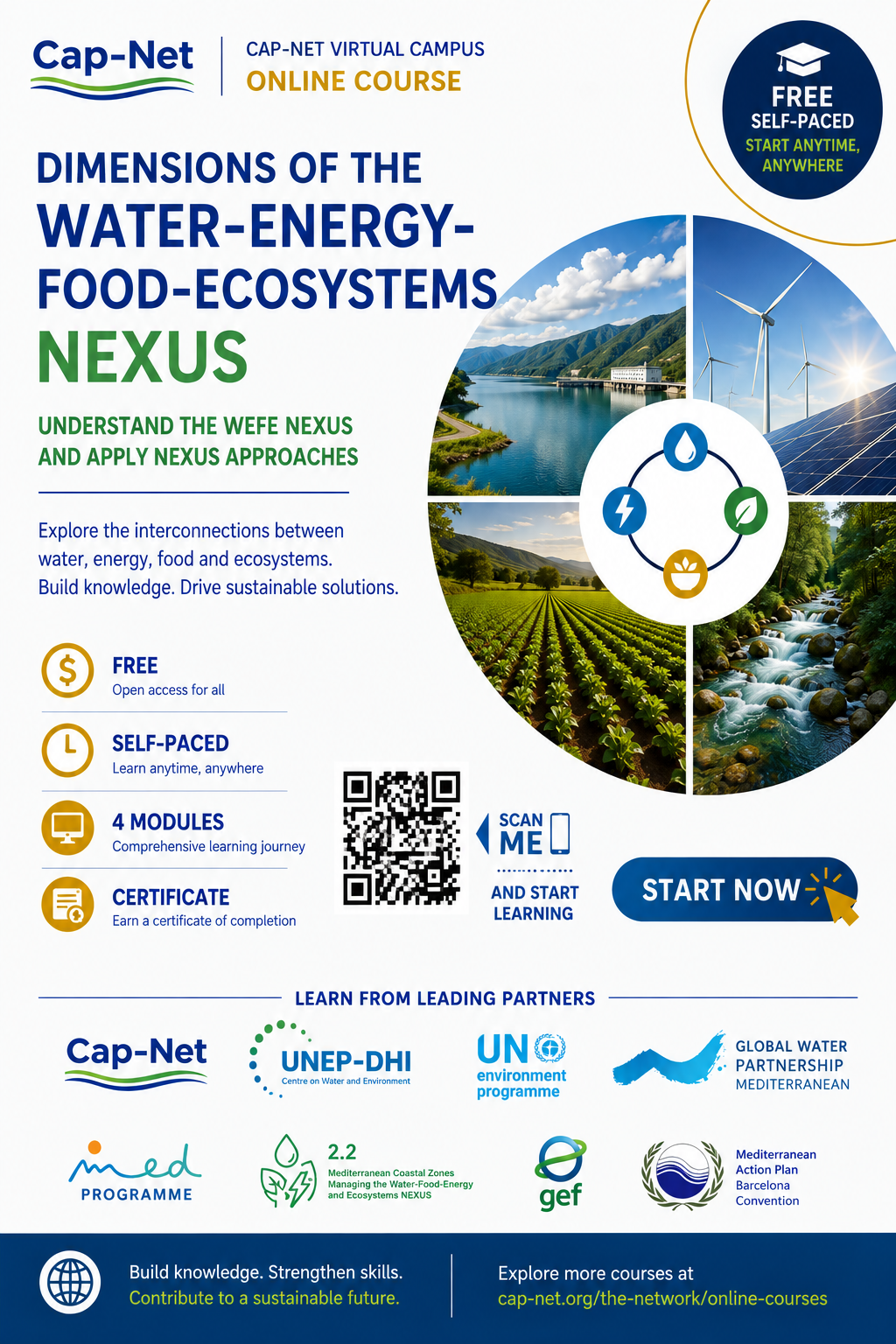
This interconnectedness is at the centre of the Water-Energy-Food-Ecosystems (WEFE) Nexus. The Nexus approach helps ensure more integrated and sustainable use of resources, reaches beyond traditional silos, and can be applied at all scales.
In partnership with Cap-Net, and the Global Water Partnership- Mediterranean (GWP-Med) the UNEP-DHI Centre is launching the course Dimensions of the Water-Energy-Food-Ecosystems Nexus.
There are four modules in the course and participants will receive a certificate issued by the course organizers upon completion of all modules. Each module provides participants with engaging resources, including readings, videos, websites, interactive forum discussions and quizzes to enhance the learning experience. The modules are as follows:
Module 1: Introduction to the WEFE Nexus
Module 2: Scenario Development and Nexus Assessments for Informed Decision-Making
Module 3: WEFE Nexus Interlinkages in the Context of Climate Change
Module 4: Operationalizing Nexus Solutions