News
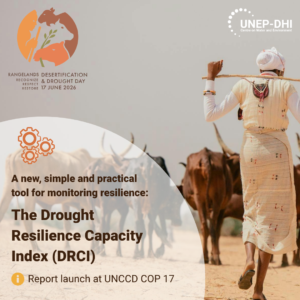
Frist glimpse at new report on Desertification and Drought Day 2026
As El Niño approaches, Desertification and Drought Day 2026 offers a first glimpse of a new UNEP‑DHI report on global drought resilience.

As El Niño approaches, Desertification and Drought Day 2026 offers a first glimpse of a new UNEP‑DHI report on global drought resilience.
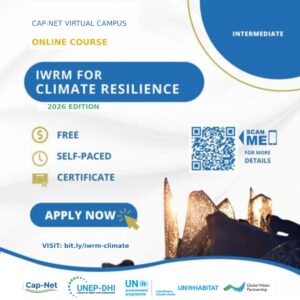
Integrated Water Resources Management for Climate Resilience, developed by UNEP-DHI in partnership with Cap-Net UNDP, UNEP Copenhagen Climate Centre, UN-Habitat, Global Water Partnership and UNDP, is an online, free and self-paced course that offers five modules designed to help practitioners plan climate resilient measures in the water sector.
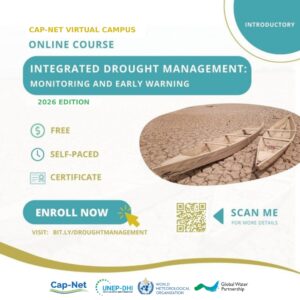
In partnership with Integrated Drought Management Programme, Cap-Net UNDP, WMO, and the Volta Flood and Drought Management project, UNEP-DHI developed an online course on Integrated Drought Management: Monitoring and Early Warning. It is designed to improve understanding of proactive integrated drought management and introduces available tools for drought monitoring and forecasting.
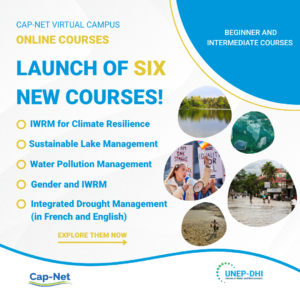
The 2026 editions of UNEP-DHI’s online training courses are now open, offering practitioners, policymakers, and water professionals worldwide the opportunity to strengthen their skills in addressing today’s most pressing water challenges.

The DHI technical team, supported by UNEP-DHI colleagues, is working together with the Viet Nam Mekong Committee (VNMC) to develop a salinity data sharing platform to enable exchange of information and near-real-time data on salinity intrusion in the Viet Nam Mekong Delta region.

UNEP-DHI provides technical assistance to strengthening climate information and multi-hazard early warning systems for increased resilience in Azerbaijan. The goal of this project is to establish capacity in Azerbaijan to make available reliable climate information services and a people-centered impact-based multi-hazard early warning system (IB-MHEWS).

The ‘Wastewater treatment solutions for climate mitigation: a practical guide’ provides practical strategies for reducing greenhouse gas emissions in the wastewater sector. It outlines methods for monitoring emissions, optimizing treatment processes, and implementing policy and technology solutions to help WWTPs move toward net-zero emissions while supporting global sanitation goals.
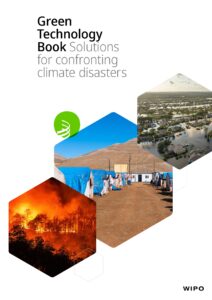
The 4th Edition Green Technology Book explores how innovation is reshaping disaster risk management in the face of climate crises. It presents practical and cutting-edge solutions, from AI forecasting to resilient infrastructure, enabled by a strong intellectual property system.

Cambodia and Lao PDR have launched Integrated Water Resources Management (IWRM) Action Plans for 2026–2030, marking a significant step toward sustainable and climate-resilient water governance.
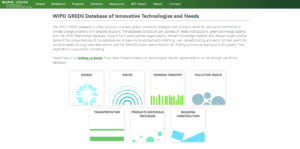
The WIPO GREEN database is a free, solutions oriented, global innovation catalogue that connects needs for solving environmental or climate change problems with tangible solutions. The database consists of user uploads of needs and solutions, green technology patents from the WIPO Patentscope database, imports from select partner organizations, relevant knowledge material, and relevant expert profiles.
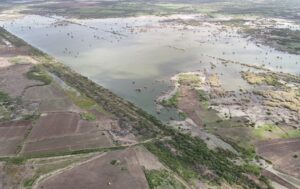
The UNEP-DHI Centre is supporting the United Nations Environment Programme (UNEP) in the five-year “RESTORE” initiative by delivering detailed hydrological assessments and decision-support modelling that will guide the rehabilitation and sustainable operation of the Jowhar Off-stream Storage Programme, strengthen flood and drought management across the Shabelle Basin, and build climate-resilient livelihoods for communities in south-central Somalia.
The UN-Water Analytical Brief on Water for Climate Mitigation discusses the dependency of climate mitigation on the use of water and the effective management of water resources and related services to ensure sustainable and effective outcomes.
